Home / Sample SPCC plan
Generated by this tool from a fictional facility
Sample SPCC plan
EPA's quick-settlement form for small facilities lists a $1,750 penalty just for having no SPCC plan. A case that goes to court can cost far more (the law allows up to $59,114 a day, 40 CFR 19.4).
An engineer's SPCC plan: $1,500 to over $10,000 (Texas A&M AgriLife Extension) or $2,000 to $4,000 (Purdue Extension); farm extension estimates from 2011 and 2013, the most recent published ranges we could verify. Sources: Texas A&M AgriLife Extension EBN-001 (2013), Purdue Extension via Farm and Dairy (2011). Ours: from $299, one time.
- Free eligibility check first
- Editable DOCX and PDF
- Every requirement cited to 40 CFR
- Missing-element guarantee, plus 30 days no questions asked
This is a real output of the generator, from one of our test cases: a fictional facility with made-up names and phone numbers. Your plan has the same structure, filled in from your own containers and answers.
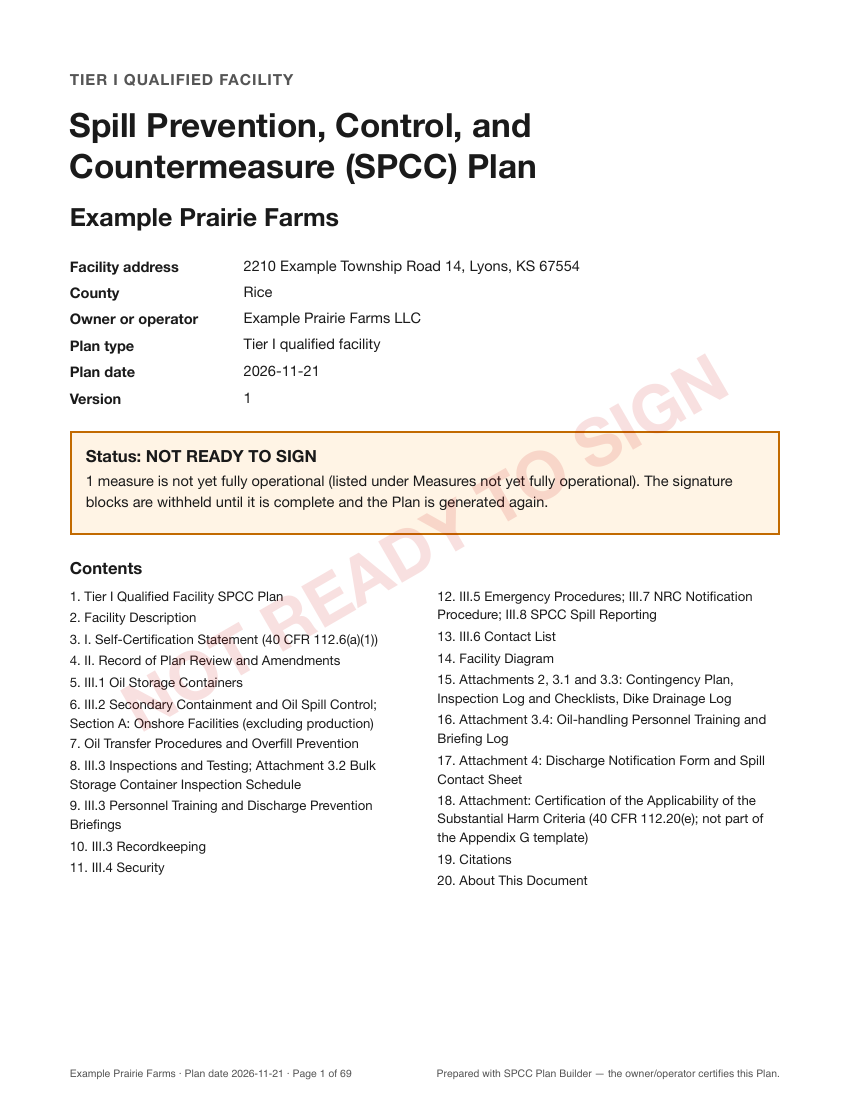
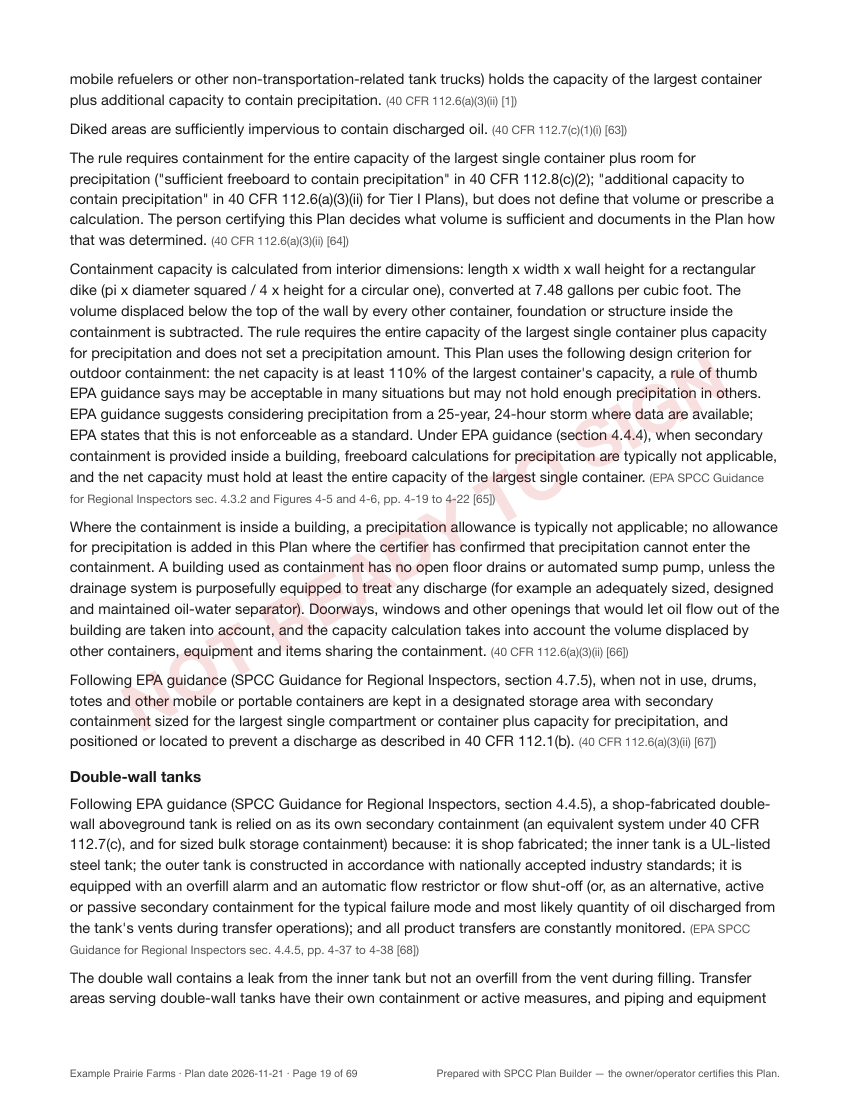
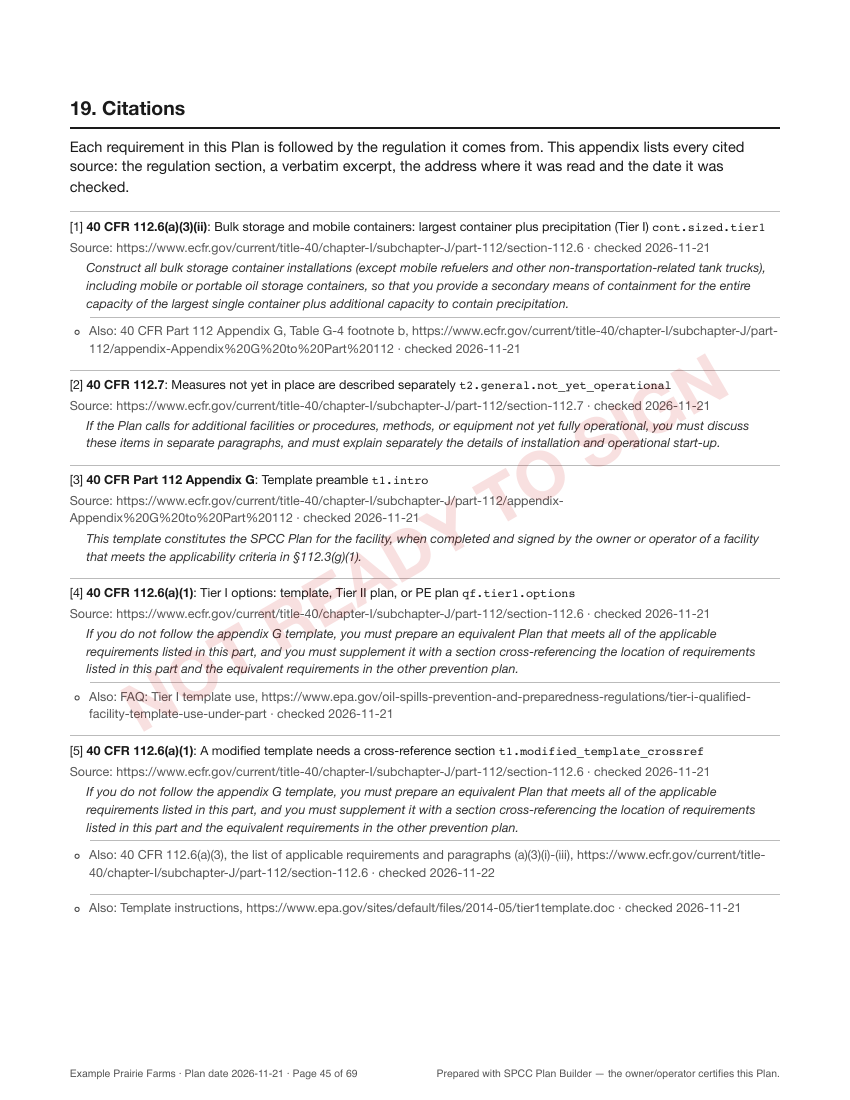
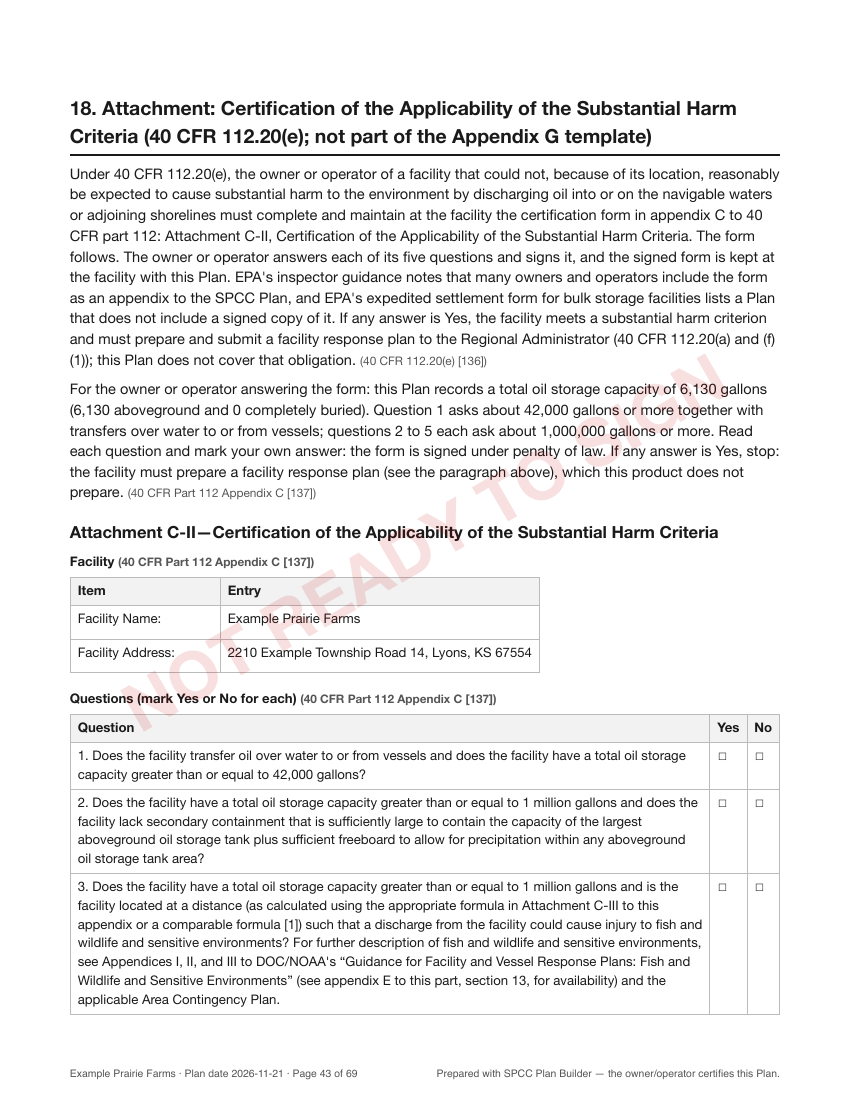
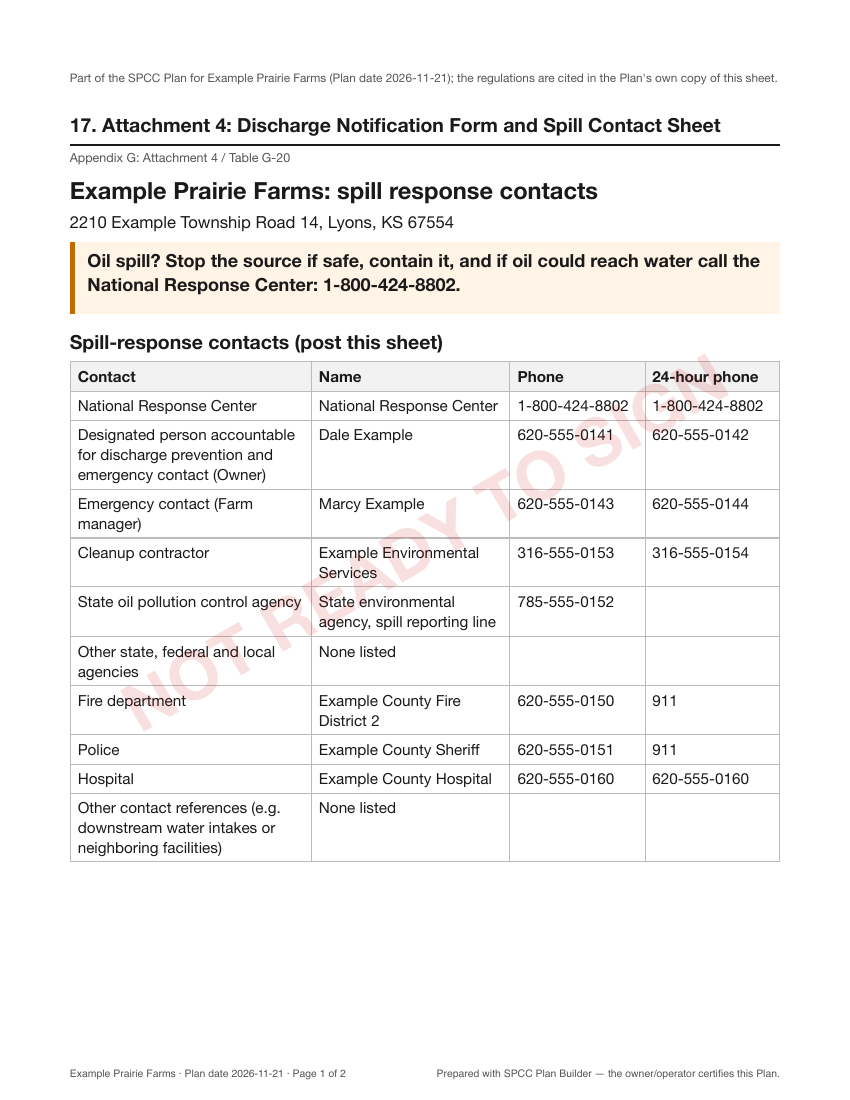
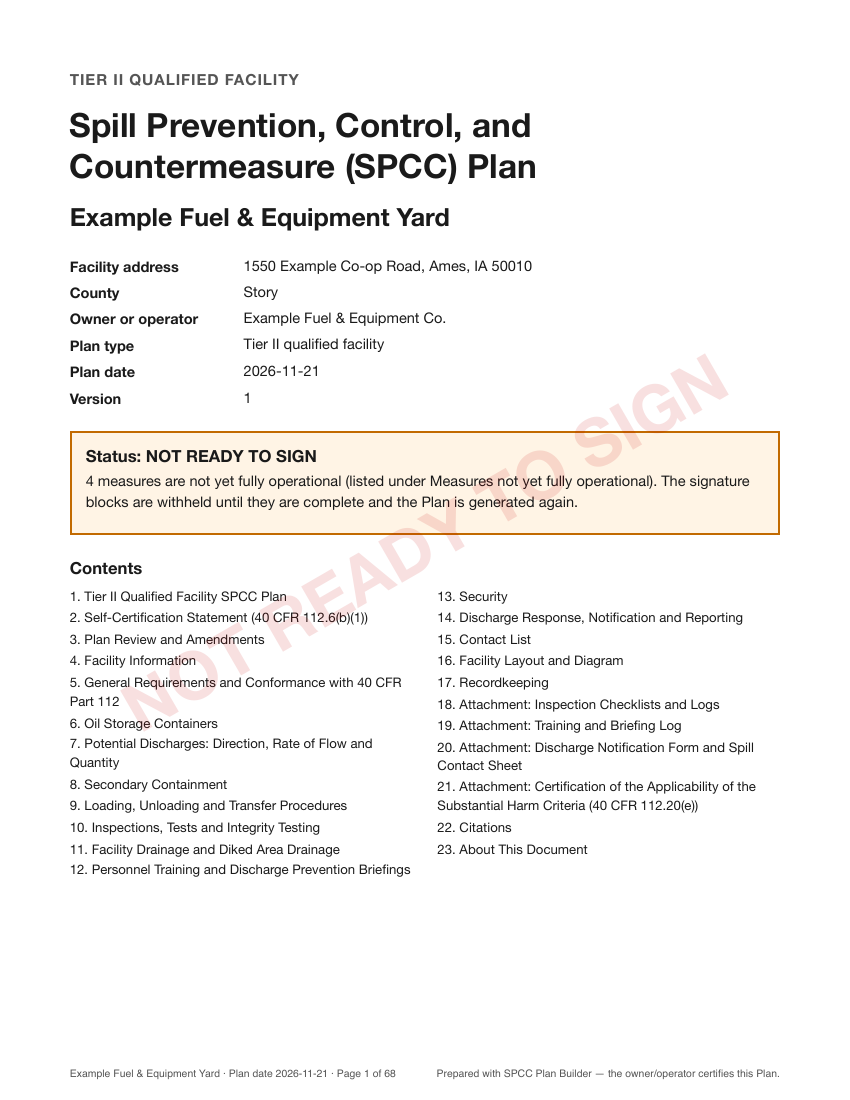
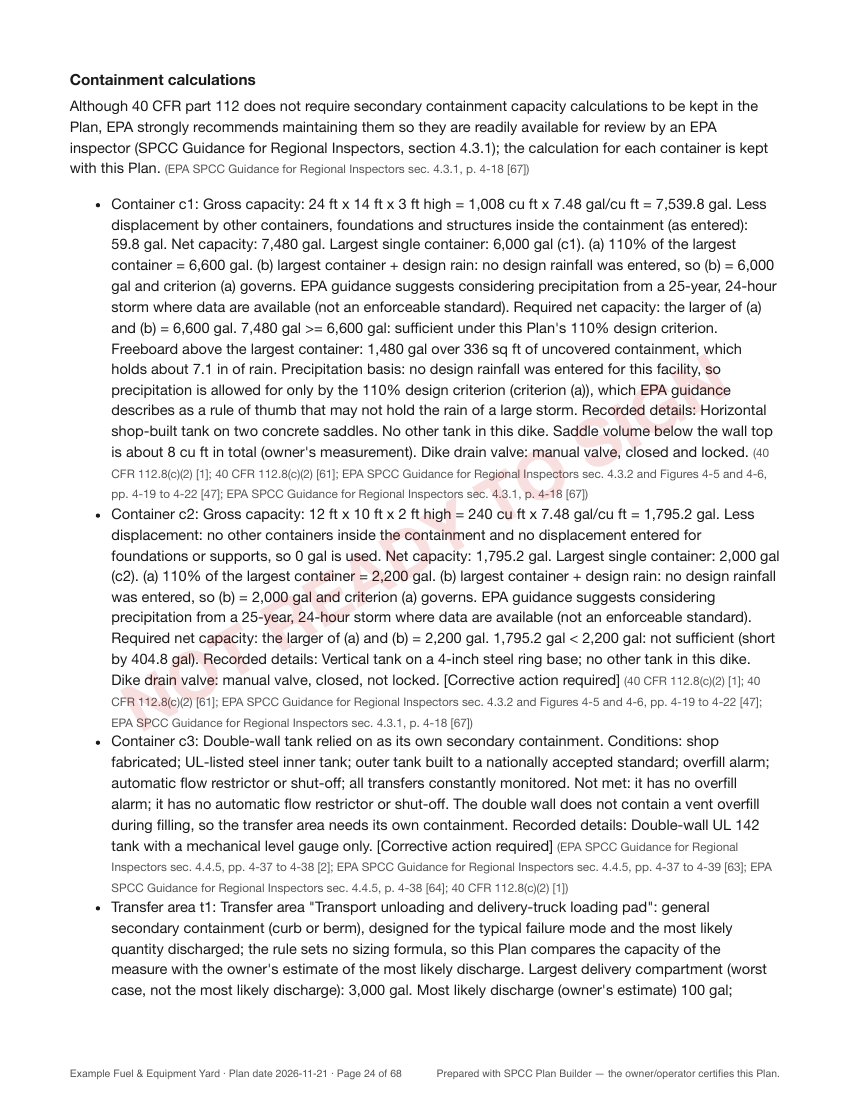
Download the full sample PDF Download the Tier II sample PDF (Example Fuel & Equipment Yard, a fictional Iowa fuel yard) Generated by this tool from fictional fixture cases (“Example Prairie Farms, a fictional Kansas row-crop farm (Tier I)” and a Tier II fuel yard), not real facilities.
What is in the plan, section by section
| Section | Tier I | Tier II |
|---|---|---|
| Cover | Yes | Yes |
| Self-certification | Yes | Yes |
| Five-year review and amendment log | Yes | Yes |
| Facility information | Yes | Yes |
| Conformance with Part 112 | No | Yes |
| Oil storage containers | Yes | Yes |
| Potential discharges | No | Yes |
| Secondary containment | Yes | Yes |
| Loading, unloading and transfers | Yes | Yes |
| Inspections and testing | Yes | Yes |
| Facility drainage | No | Yes |
| Personnel training | Yes | Yes |
| Security | Yes | Yes |
| Discharge response and notification | Yes | Yes |
| Emergency contacts | Yes | Yes |
| Facility diagram | Yes | Yes |
| Records | Yes | Yes |
| Inspection checklists | Yes | Yes |
| Training and briefing log | Yes | Yes |
| Spill-response contact sheet | Yes | Yes |
| Citation appendix | Yes | Yes |
| Disclaimer | Yes | Yes |
Tier I plans are arranged in the order of EPA's Tier I template (Appendix G). Because some content is added (calculations, diagram, checklists), the plan includes a cross-reference table showing where each template section is: This Plan is an equivalent Plan under 40 CFR 112.6(a)(1): it covers every section of the Appendix G template in a different layout and meets the applicable requirements of 40 CFR part 112. As that paragraph requires, it is supplemented with a cross-reference section showing where each requirement listed in 40 CFR 112.6(a)(3) and each Appendix G section is addressed in this Plan. (40 CFR 112.6(a)(1))
How it maps to what an inspector checks
| What they check | Required by | Section of your plan | Plans |
|---|---|---|---|
| Signed certification by the owner or operator | Qualified facilities may self-certify 40 CFR 112.3(g), 40 CFR 112.6(a)(1)(ii) | Self-certification | Tier I and II |
| Management approval to commit resources | Full approval of management 40 CFR 112.7 | Self-certification | Tier I and II |
| Facility name, address and owner | Facility Description 40 CFR Part 112 Appendix G | Facility information | Tier I and II |
| Every oil container of 55 gallons or more, with oil type and capacity | III.1 Oil Storage Containers (Table G-2) 40 CFR Part 112 Appendix G, 40 CFR 112.7(a)(3)(i) | Oil storage containers | Tier I and II |
| Facility diagram with container locations Included in Tier I plans too, though not required there | Physical layout and facility diagram 40 CFR 112.7(a)(3) | Facility diagram | Tier II |
| Secondary containment sized for the largest container plus rain | Bulk storage and mobile containers: largest container plus precipitation (Tier I) 40 CFR 112.6(a)(3)(ii), 40 CFR 112.8(c)(2), EPA SPCC Guidance for Regional Inspectors sec. 4.3.1, p. 4-18 | Secondary containment | Tier I and II |
| General containment for transfer areas, piping and equipment | General secondary containment for all oil-handling areas 40 CFR 112.7(c) | Secondary containment | Tier I and II |
| Overfill prevention for each container | Tier I: overfill prevention system or documented procedure 40 CFR 112.6(a)(3)(iii), 40 CFR 112.8(c)(8) | Loading, unloading and transfers | Tier I and II |
| Loading, unloading and transfer procedures Tier I plans print the transfer steps as the way the overfill and containment requirements are carried out; 112.7(a)(3)(ii) is not a Tier I requirement | Procedures for routine handling of products 40 CFR 112.7(a)(3)(ii) | Loading, unloading and transfers | Tier II |
| Inspection and integrity testing schedule per an industry standard | Integrity test or inspect each aboveground container on a regular schedule 40 CFR 112.8(c)(6), 40 CFR Part 112 Appendix G | Inspections and testing | Tier I and II |
| Signed inspection records kept three years | Keep signed inspection records with the Plan for three years 40 CFR 112.7(e) | Records | Tier I and II |
| Rainwater drainage from diked areas, with a log Tier I plans have no separate drainage section: this is Section A (Table G-10) in the containment section, with the Attachment 3.3 log | Draining rainwater from diked areas 40 CFR 112.8(c)(3) | Facility drainage | Tier I and II |
| Training of oil-handling personnel | Train oil-handling personnel 40 CFR 112.7(f)(1) | Personnel training | Tier I and II |
| A named person accountable for discharge prevention | Designated person accountable for discharge prevention 40 CFR 112.7(f)(2) | Personnel training | Tier I and II |
| Discharge prevention briefing at least once a year, with a log | Discharge prevention briefing at least once a year 40 CFR 112.7(f)(3), 40 CFR Part 112 Appendix G | Personnel training | Tier I and II |
| Security: access, valves, pump starters, connections, lighting | Describe security measures 40 CFR 112.7(g) | Security | Tier I and II |
| What staff do when oil is spilled | Countermeasures for discharge discovery, response and cleanup 40 CFR 112.7(a)(3)(iv) | Discharge response and notification | Tier I and II |
| Emergency contact list including the National Response Center | Contact list and phone numbers 40 CFR 112.7(a)(3)(vi), 40 CFR Part 112 Appendix G | Emergency contacts | Tier I and II |
| What to report after a discharge, and the 60-day report trigger | Information to give when reporting a discharge 40 CFR 112.7(a)(4), 40 CFR 112.4(a) | Discharge response and notification | Tier I and II |
| Five-year review log and amendment record | Review and evaluate the Plan at least once every five years 40 CFR 112.5(b) | Five-year review and amendment log | Tier I and II |
| Where the plan is kept | Where the Plan is kept 40 CFR 112.3(e)(1) | Records | Tier I and II |
Things to look for in the sample
- The certification page uses the Tier I statement wording from Appendix G, for the owner to sign after visiting the facility (40 CFR 112.6(a)(1)(ii)).
- Containment calculations show gross volume, displacement, the requirement and the result for each container, as the method requires (EPA SPCC Guidance for Regional Inspectors sec. 4.3.2 and Figures 4-5 and 4-6, pp. 4-19 to 4-22).
- Open items (for example a basin that is too small) are listed as corrective actions with target dates, not left out.
- The citation appendix lists every rule the plan relies on with its CFR paragraph, URL, a verbatim quote and the date we checked it.
- The disclaimer is one line: This Plan is self-certified by the facility owner or operator under 40 CFR 112.6. It has not been reviewed or certified by a Professional Engineer, and the document tool that helped prepare it does not certify it.
Find out in a few questions whether you need a plan, and which tier
The eligibility check is free and needs no account. You see your result, why, and the rule behind it, before anything is for sale. If you need an engineer, it says so.
Start the free eligibility checkWhat exactly do I get?
An editable Word (DOCX) file and a print-ready PDF of the complete plan: certification page, facility information, container table, containment calculations, inspection program, training, security, spill response and contacts, facility diagram, review log, inspection checklists for each container type, a training log, a spill-response contact sheet to post, and a citation appendix. You can see one on the sample plan page.
Is a plan made with this tool accepted?
EPA does not pre-approve SPCC plans, and you do not file yours with EPA: you keep it at the facility and show it on request (40 CFR 112.3(e)). What makes a plan acceptable is that it contains every element Part 112 requires for your facility, that it is certified by the right person, and that you actually do what it says. For a qualified facility, the right person is you: the owner or operator may self-certify (40 CFR 112.3(g)).
Our Tier I plans cover every section of EPA's own Appendix G template, with a cross-reference to each template section and each requirement 112.6(a)(3) lists, and Tier II plans include a cross-reference to every applicable paragraph of 112.7 and 112.8. Every requirement in the plan prints its 40 CFR citation, so an inspector can check it against the rule. One caution: Compliance with 40 CFR part 112 does not relieve the owner or operator from compliance with other Federal, State, or local laws (40 CFR 112.1(e)). EPA notes that some states do not allow self-certification and advises consulting your state to make sure SPCC Plan certification is not limited to Professional Engineers.
What if my site is unusual?
The intake asks about each container separately: shop-built or factory, single or double wall, indoors or out, what containment it has, and how it is filled. Anything the rules treat differently (mobile refuelers, oil-filled equipment, double-wall tanks, buried piping, a dike with several tanks in it) gets its own plan text and calculation. Where your answers show a gap, such as containment that is too small, the plan says so on the cover, leaves that item unchecked, and lists the work as its own paragraph with the target date you set, instead of hiding it.
Some situations are outside what a self-certified plan can do, and we say so: oil production facilities, and any spot where you would claim containment is impracticable (40 CFR 112.6(a)(1)(vii)). Those need a PE.
Related
A document tool, not engineering or legal advice. You, the owner or operator, certify the plan.
Sources cited on this page
Regulation text from the eCFR, quoted verbatim, with the date we last checked it. See how we check sources.
- 40 CFR 19.4: Civil judicial penalty for failing to comply with SPCC regulations (CWA 311(b)(7)(C)). Checked 2026-11-21.
“| 33 U.S.C. 1321(b)(7)(C) | CWA | 59,114 | 57,617 | 25,000 |”
- 40 CFR 112.3(e): The Plan is not filed with EPA. Checked 2026-11-21.
“Maintain a complete copy of the Plan at the facility if the facility is normally attended at least four hours per day, or at the nearest field office if the facility is not so attended, and (2) Have the Plan available to the Regional Administrator for on-site review during normal working hours.”
- 40 CFR 112.3(e)(1): Where the Plan is kept. Checked 2026-11-21.
“Maintain a complete copy of the Plan at the facility if the facility is normally attended at least four hours per day, or at the nearest field office if the facility is not so attended, and”
- 40 CFR 112.3(g): Qualified facilities may self-certify. Checked 2026-11-21.
“The owner or operator of a qualified facility as defined in this subparagraph may self-certify his facility's Plan, as provided in § 112.6.”
- 40 CFR 112.3(g): The owner or operator certifies, not this product. Checked 2026-11-21.
“The owner or operator of a qualified facility as defined in this subparagraph may self-certify his facility's Plan, as provided in § 112.6.”
- 40 CFR 112.4(a): Report to the EPA Regional Administrator within 60 days after large or repeated discharges. Checked 2026-11-21.
“whenever your facility has discharged more than 1,000 U.S. gallons of oil in a single discharge as described in § 112.1(b), or discharged more than 42 U.S. gallons of oil in each of two discharges as described in § 112.1(b), occurring within any twelve month period, submit the following information to the Regional Administrator within 60 days from the time the facility becomes subject to this section:”
- 40 CFR 112.5(b): Review and evaluate the Plan at least once every five years. Checked 2026-11-21.
“complete a review and evaluation of the SPCC Plan at least once every five years from the date your facility becomes subject to this part; or, if your facility was in operation on or before August 16, 2002, five years from the date your last review was required under this part.”
- 40 CFR 112.5(b): Document each review and sign whether the Plan will be amended. Checked 2026-11-21.
“You must document your completion of the review and evaluation, and must sign a statement as to whether you will amend the Plan, either at the beginning or end of the Plan or in a log or an appendix to the Plan.”
- 40 CFR 112.6(a)(1): A modified template needs a cross-reference section. Checked 2026-11-21.
“If you do not follow the appendix G template, you must prepare an equivalent Plan that meets all of the applicable requirements listed in this part, and you must supplement it with a section cross-referencing the location of requirements listed in this part and the equivalent requirements in the other prevention plan.”
- 40 CFR 112.6(a)(1)(ii): The certifying owner or operator visits and examines the facility (personally, per EPA's FAQ). Checked 2026-11-21.
“You have visited and examined the facility;”
- 40 CFR 112.6(a)(1)(vii): Tier I: impracticability is not available. Checked 2026-11-21.
“The Plan does not deviate from any requirement of this part as allowed by § 112.7(a)(2) and 112.7(d) or include measures pursuant to § 112.9(c)(6) for produced water containers and any associated piping; and”
- 40 CFR 112.6(a)(3)(ii): Bulk storage and mobile containers: largest container plus precipitation (Tier I). Checked 2026-11-21.
“Construct all bulk storage container installations (except mobile refuelers and other non-transportation-related tank trucks), including mobile or portable oil storage containers, so that you provide a secondary means of containment for the entire capacity of the largest single container plus additional capacity to contain precipitation.”
- 40 CFR 112.6(a)(3)(iii): Tier I: overfill prevention system or documented procedure. Checked 2026-11-21.
“Ensure that each container is provided with a system or documented procedure to prevent overfills of the container, describe the system or procedure in the SPCC Plan and regularly test to ensure proper operation or efficacy.”
- 40 CFR 112.7: Full approval of management. Checked 2026-11-21.
“The Plan must have the full approval of management at a level of authority to commit the necessary resources to fully implement the Plan.”
- 40 CFR 112.7(a)(3): Physical layout and facility diagram. Checked 2026-11-21.
“Describe in your Plan the physical layout of the facility and include a facility diagram, which must mark the location and contents of each fixed oil storage container and the storage area where mobile or portable containers are located.”
- 40 CFR 112.7(a)(3)(i): Type of oil and capacity of each container. Checked 2026-11-21.
“The type of oil in each fixed container and its storage capacity. For mobile or portable containers, either provide the type of oil and storage capacity for each container or provide an estimate of the potential number of mobile or portable containers, the types of oil, and anticipated storage capacities;”
- 40 CFR 112.7(a)(3)(ii): Procedures for routine handling of products. Checked 2026-11-21.
“Discharge prevention measures including procedures for routine handling of products (loading, unloading, and facility transfers, etc.);”
- 40 CFR 112.7(a)(3)(iv): Countermeasures for discharge discovery, response and cleanup. Checked 2026-11-21.
“Countermeasures for discharge discovery, response, and cleanup (both the facility's capability and those that might be required of a contractor);”
- 40 CFR 112.7(a)(3)(vi): Contact list and phone numbers. Checked 2026-11-21.
“Contact list and phone numbers for the facility response coordinator, National Response Center, cleanup contractors with whom you have an agreement for response, and all appropriate Federal, State, and local agencies who must be contacted in case of a discharge as described in § 112.1(b).”
- 40 CFR 112.7(a)(4): Information to give when reporting a discharge. Checked 2026-11-21.
“provide information and procedures in your Plan to enable a person reporting a discharge as described in § 112.1(b) to relate information on the exact address or location and phone number of the facility; the date and time of the discharge, the type of material discharged; estimates of the total quantity discharged; estimates of the quantity discharged as described in § 112.1(b); the source of the discharge; a description of all affected media; the cause of the discharge; any damages or injuries caused by the discharge; actions being used to stop, remove, and mitigate the effects of the discharge; whether an evacuation may be needed; and, the names of individuals and/or organizations who have also been contacted.”
- 40 CFR 112.7(c): General secondary containment for all oil-handling areas. Checked 2026-11-21.
“Provide appropriate containment and/or diversionary structures or equipment to prevent a discharge as described in § 112.1(b), except as provided in paragraph (k) of this section for qualified oil-filled operational equipment”
- 40 CFR 112.7(c): Transfer areas need general secondary containment. Checked 2026-11-21.
“Provide appropriate containment and/or diversionary structures or equipment to prevent a discharge as described in § 112.1(b)”
- 40 CFR 112.7(e): Keep signed inspection records with the Plan for three years. Checked 2026-11-21.
“You must keep these written procedures and a record of the inspections and tests, signed by the appropriate supervisor or inspector, with the SPCC Plan for a period of three years.”
- 40 CFR 112.7(f)(1): Train oil-handling personnel. Checked 2026-11-21.
“At a minimum, train your oil-handling personnel in the operation and maintenance of equipment to prevent discharges; discharge procedure protocols; applicable pollution control laws, rules, and regulations; general facility operations; and, the contents of the facility SPCC Plan.”
- 40 CFR 112.7(f)(2): Designated person accountable for discharge prevention. Checked 2026-11-21.
“Designate a person at each applicable facility who is accountable for discharge prevention and who reports to facility management.”
- 40 CFR 112.7(f)(3): Discharge prevention briefing at least once a year. Checked 2026-11-21.
“Schedule and conduct discharge prevention briefings for your oil-handling personnel at least once a year to assure adequate understanding of the SPCC Plan for that facility.”
- 40 CFR 112.7(g): Describe security measures. Checked 2026-11-21.
“Describe in your Plan how you secure and control access to the oil handling, processing and storage areas; secure master flow and drain valves; prevent unauthorized access to starter controls on oil pumps; secure out-of-service and loading/unloading connections of oil pipelines; and address the appropriateness of security lighting to both prevent acts of vandalism and assist in the discovery of oil discharges.”
- 40 CFR 112.8(c)(2): Bulk storage: largest container plus freeboard for precipitation (Tier II). Checked 2026-11-21.
“Construct all bulk storage tank installations (except mobile refuelers and other non-transportation-related tank trucks) so that you provide a secondary means of containment for the entire capacity of the largest single container and sufficient freeboard to contain precipitation.”
- 40 CFR 112.8(c)(3): Draining rainwater from diked areas. Checked 2026-11-21.
“Not allow drainage of uncontaminated rainwater from the diked area into a storm drain or discharge of an effluent into an open watercourse, lake, or pond, bypassing the facility treatment system unless you: (i) Normally keep the bypass valve sealed closed. (ii) Inspect the retained rainwater to ensure that its presence will not cause a discharge as described in § 112.1(b). (iii) Open the bypass valve and reseal it following drainage under responsible supervision; and (iv) Keep adequate records of such events”
- 40 CFR 112.8(c)(6): Integrity test or inspect each aboveground container on a regular schedule. Checked 2026-11-21.
“Test or inspect each aboveground container for integrity on a regular schedule and whenever you make material repairs.”
- 40 CFR 112.8(c)(8): Tier II: at least one overfill prevention device per container installation. Checked 2026-11-21.
“Engineer or update each container installation in accordance with good engineering practice to avoid discharges. You must provide at least one of the following devices:”
- 40 CFR Part 112 Appendix G: Facility Description. Checked 2026-11-21.
“Facility Description Facility Name Facility Address”
- 40 CFR Part 112 Appendix G: III.1 Oil Storage Containers (Table G-2). Checked 2026-11-21.
“1. Oil Storage Containers (§112.7(a)(3)(i)):”
- 40 CFR Part 112 Appendix G: Tier I: inspect shop-built containers per a recognized standard, at least Table G-17. Checked 2026-11-21.
“To comply with integrity inspection requirement for bulk storage containers, inspect/test each shop-built aboveground bulk storage container on a regular schedule in accordance with a recognized container inspection standard based on the minimum requirements in the following table.”
- 40 CFR Part 112 Appendix G: Attachment 3.4 Oil-handling Personnel Training and Briefing Log (Table G-19). Checked 2026-11-21.
“ATTACHMENT 3.4 - Oil-handling Personnel Training and Briefing Log”
- 40 CFR Part 112 Appendix G: National Response Center phone number. Checked 2026-11-21.
“National Response Center (NRC) 1-800-424-8802”
- EPA SPCC Guidance for Regional Inspectors sec. 4.3.1, p. 4-18: Keep the containment calculations with the Plan. Checked 2026-11-21.
“While the rule does not require that secondary containment calculations be kept in the Plan, EPA strongly recommends that the facility owner or operator maintain the calculations”
- EPA SPCC Guidance for Regional Inspectors sec. 4.3.2 and Figures 4-5 and 4-6, pp. 4-19 to 4-22: Containment sizing calculation (EPA guidance method). Checked 2026-11-21.
“A “110 percent of storage tank capacity” rule of thumb may be an acceptable design criterion in many situations”
- EPA web page: Is My Facility a "Qualified Facility" under the SPCC Rule?: Some states do not allow self-certification. Checked 2026-11-22.
“However, please note that some states do not allow self-certification. You should consult with your state to ensure that SPCC Plan certification is not limited to PEs.”
- EPA 2023 SPCC Expedited Settlement form (2023): $1,750.
“Failure to have a Spill Prevention Control and Countermeasure Plan 112.3 ($1,750)”