Home / SPCC for farms
Does your farm need an SPCC plan? Find out free in 2 minutes
EPA's quick-settlement form for small facilities lists a $1,750 penalty just for having no SPCC plan. A case that goes to court can cost far more (the law allows up to $59,114 a day, 40 CFR 19.4).
Farms with more than 6,000 and less than 20,000 gallons, no tank over 10,000 gallons and no reportable spill history may sign their own plan, without an engineer (WRRDA 2014 sec. 1049(b)(2), 33 U.S.C. 1361 note). Your lender or insurer asking? The check tells you which band you are in, and you can print the result.
An engineer's SPCC plan: $1,500 to over $10,000 (Texas A&M AgriLife Extension) or $2,000 to $4,000 (Purdue Extension); farm extension estimates from 2011 and 2013, the most recent published ranges we could verify. Sources: Texas A&M AgriLife Extension EBN-001 (2013), Purdue Extension via Farm and Dairy (2011). Ours: from $299, one time.
- Free eligibility check first
- Editable DOCX and PDF
- Every requirement cited to 40 CFR
- Missing-element guarantee, plus 30 days no questions asked
The short answer: count your gallons
Add up the size (nameplate capacity) of every aboveground tank, drum and tote of 55 gallons or more on the farm, including fuel trailers and nurse tanks. Then find your row. A 2014 law, WRRDA section 1049, set these farm bands; they are not yet written into 40 CFR Part 112, which is why some EPA pages still say 1,320 gallons.
| Oil stored above ground | Do you need a plan? | Who signs it |
|---|---|---|
| Less than 2,500 gallons | No (WRRDA 2014 sec. 1049(b)(4), 33 U.S.C. 1361 note) | Nobody |
| More than 2,500 and less than 6,000 gallons | No, if the farm has no reportable oil spill history (WRRDA 2014 sec. 1049(b)(3), 33 U.S.C. 1361 note) | Nobody |
| More than 6,000 and less than 20,000 gallons | Yes (WRRDA 2014 sec. 1049(b)(2), 33 U.S.C. 1361 note) | You, if no tank is over 10,000 gallons and there is no reportable spill history. This tool writes plans up to 10,000 gallons in total (see below). |
| 20,000 gallons or more, or any tank over 10,000 gallons, or a reportable spill history | Yes (WRRDA 2014 sec. 1049(b)(1), 33 U.S.C. 1361 note) | A Professional Engineer |
"Reportable oil spill history" is defined in the statute. The wording of each band, as the law states it: the bands in full. Adding a container can move you up a band: a 6,000-gallon line is easy to cross with one more fuel trailer.
Worked example: a corn and soybean farm
Our own example, not a real farm: a 4,000-gallon diesel tank, a 1,000-gallon gasoline tank on a stand and six 55-gallon drums of hydraulic and engine oil add up to 5,330 gallons. With no oil spill history, that is in the second row: no SPCC plan is required. Add a 1,000-gallon diesel trailer and it is 6,330 gallons: the farm needs a plan, and the owner can sign it.
My lender or insurer wrote "SPCC plan?"
Run the free check. If it says the rule does not apply, you can print a one-page record of the result: the containers you counted, the total, and the rule and source behind the answer, with a line for your signature. Hand that to your lender with the EPA links on it. If they want a plan anyway, ask them what they need in writing; we only sell plans to facilities the rule covers. If the check says you need a plan, the plan lists any containment or equipment that is not in place yet, with your target date for each, as the rule asks (40 CFR 112.7).
Start the free eligibility checkThe bands in full
- Under section 1049(b)(4) of the Water Resources Reform and Development Act of 2014 (Pub. L. 113-121, 33 U.S.C. 1361 note), EPA does not require compliance with the SPCC rule by a farm with an aggregate aboveground storage capacity of less than 2,500 gallons. For this calculation the aggregate excludes containers on separate parcels with a capacity of 1,000 gallons or less and containers holding animal feed ingredients approved for use in livestock feed by FDA. (WRRDA 2014 sec. 1049(b)(4), 33 U.S.C. 1361 note)
- Under section 1049(b)(3) of the Water Resources Reform and Development Act of 2014 (33 U.S.C. 1361 note), EPA does not require compliance with the SPCC rule by a farm with an aggregate aboveground storage capacity greater than 2,500 gallons and less than 6,000 gallons (the statutory 6,000-gallon figure, which EPA may adjust by rule to not less than 2,500 gallons) that has no reportable oil discharge history as defined in section 1049(a)(6). The aggregate excludes containers on separate parcels with a capacity of 1,000 gallons or less and containers holding animal feed ingredients approved for use in livestock feed by FDA. (WRRDA 2014 sec. 1049(b)(3), 33 U.S.C. 1361 note)
- Under section 1049(b) of the Water Resources Reform and Development Act of 2014 (33 U.S.C. 1361 note), the owner or operator of a farm may self-certify the SPCC Plan if the farm has an aggregate aboveground storage capacity greater than 6,000 gallons and less than 20,000 gallons, no individual tank with an aboveground storage capacity greater than 10,000 gallons, and no reportable oil discharge history as defined in section 1049(a)(6). (WRRDA 2014 sec. 1049(b)(2), 33 U.S.C. 1361 note)
- Under section 1049(b)(1) of the Water Resources Reform and Development Act of 2014 (33 U.S.C. 1361 note), a farm that is subject to the SPCC rule must have its SPCC Plan certified by a professional engineer if it has an individual tank with an aboveground storage capacity greater than 10,000 gallons, an aggregate aboveground storage capacity greater than or equal to 20,000 gallons, or a reportable oil discharge history as defined in section 1049(a)(6). (WRRDA 2014 sec. 1049(b)(1), 33 U.S.C. 1361 note)
A farm at exactly 2,500 or exactly 6,000 gallons falls in none of the statute's bands, so the codified rule applies to it unchanged. The free check handles those edge cases.
What counts as a farm: A farm is a facility on a tract of land devoted to producing crops or raising animals (including fish) that produced and sold, or normally would have produced and sold, $1,000 or more of agricultural products during a year. (40 CFR 112.2)
What you do not count on a farm
- When calculating a farm's aggregate aboveground oil storage capacity for the WRRDA farm thresholds, do not count all containers on separate parcels that have a capacity of 1,000 gallons or less, or containers holding animal feed ingredients approved for use in livestock feed by FDA (WRRDA 2014 sec. 1049(c), 33 U.S.C. 1361 note, as amended by the WIIN Act 2016 sec. 5011). Under the same amendment, Part 112 does not apply to farm containers on a separate parcel that have an individual capacity of not greater than 1,000 gallons and an aggregate capacity of not greater than 2,500 gallons, or to containers holding FDA-approved animal feed ingredients. The SPCC rule's own exemptions in 40 CFR 112.1(d), which EPA's farm fact sheet also lists, apply as well: containers for heating oil used solely at a single-family residence; pesticide application equipment or related mix containers; milk and milk product containers and associated piping and appurtenances; and completely buried tanks subject to all of the technical requirements of 40 CFR part 280 or a State program approved under part 281. (WRRDA 2014 sec. 1049(c), 33 U.S.C. 1361 note, as amended by WIIN Act 2016 sec. 5011)
- Any onboard bulk storage container used primarily to power the movement of a motor vehicle, or ancillary onboard oil-filled operational equipment (excluding oil drilling or workover equipment, including rigs), is exempt and not counted. An onboard bulk storage container used to store or transfer oil for further distribution, such as a fuel or service truck, is not a motive power container. The transfer of fuel or other oil into a motive power container at an otherwise regulated facility is not eligible for this exemption. (40 CFR 112.1(d)(7))
- Containers under 55 gallons (40 CFR 112.1(d)(5)).
Nurse tanks and fuel trailers that haul fuel to the field are not motive power containers; they count toward capacity, and they need general containment such as sorbents or a curbed parking area where they sit: Mobile refuelers (as defined in 40 CFR 112.2) and other non-transportation-related tank trucks are excepted from sized bulk storage containment, but remain subject to general secondary containment under 40 CFR 112.7(c) for the typical failure mode and most likely quantity of oil discharged, such as sorbents or curbing. As EPA guidance explains, the exception from sized containment does not apply to vehicles used primarily to store oil in a stationary location. (40 CFR 112.7(c))
What you get if your farm needs a plan
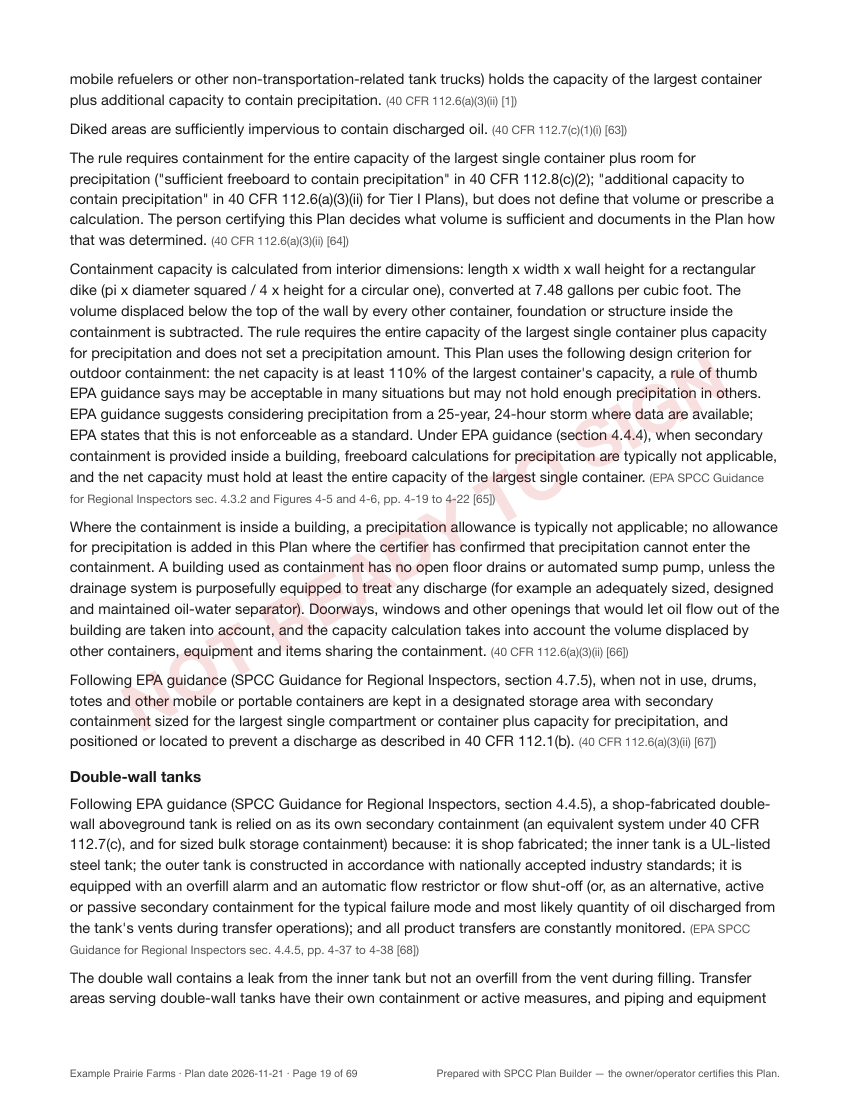
A plan built from your tanks, with the containment arithmetic for each one, an inspection schedule and checklists, the yearly briefing log and a contact sheet to post. Here is a page from the sample plan this tool made for a fictional Kansas farm.
| What they check | Required by | Section of your plan | Plans |
|---|---|---|---|
| Signed certification by the owner or operator | Qualified facilities may self-certify 40 CFR 112.3(g), 40 CFR 112.6(a)(1)(ii) | Self-certification | Tier I and II |
| Management approval to commit resources | Full approval of management 40 CFR 112.7 | Self-certification | Tier I and II |
| Facility name, address and owner | Facility Description 40 CFR Part 112 Appendix G | Facility information | Tier I and II |
See all 21 elements an inspector checks, each with the section of your plan that covers it.
If your farm needs a plan
A farm that self-certifies still has to meet the same plan requirements as any qualified facility. On a typical farm the work is in four places:
- Containment around the bulk fuel tanks. Secondary containment for the bulk storage containers (including mobile or portable oil storage containers, but not mobile refuelers or other non-transportation-related tank trucks) holds the capacity of the largest container plus additional capacity to contain precipitation. (40 CFR 112.6(a)(3)(ii)) Check your dike or pad with the containment calculator.
- Overfill prevention for deliveries. Each container has a system or documented procedure to prevent overfills, described in this Plan, and it is regularly tested to ensure proper operation or efficacy. (40 CFR 112.6(a)(3)(iii))
- Monthly visual checks of tanks and drums, logged and kept for 3 years: Portable containers (including drums, totes, and intermodal bulk containers (IBC)): visually inspect every 1 month(s) for signs of deterioration, discharges or accumulation of oil inside diked areas. (40 CFR Part 112 Appendix G)
- A yearly briefing for anyone who handles fuel. Discharge prevention briefings for oil-handling personnel are scheduled and conducted at least once every 1 year to assure adequate understanding of this SPCC Plan. (40 CFR 112.7(f)(3))
When you needed it: A farm (as defined in 40 CFR 112.2) in operation on or before 2002-08-16 had to maintain its Plan, amend it if necessary to ensure compliance with 40 CFR part 112, and implement the amended Plan on or before 2013-05-10; a farm that became operational after 2002-08-16 through 2013-05-10, and could reasonably be expected to have a discharge as described in 40 CFR 112.1(b), had to prepare and implement a Plan on or before 2013-05-10; and a farm that becomes operational after 2013-05-10, and could reasonably be expected to have a discharge as described in 40 CFR 112.1(b), must prepare and implement a Plan before it begins operations. (40 CFR 112.3(a)(3))
How this tool handles farms
- The free check applies the statutory farm bands first, then the codified qualified-facility tests, and tells you which result applies and why.
- If your farm can self-certify and is also within the Tier I limits (10,000 gallons total, no container over 5,000 gallons), you get a Tier I plan in the Appendix G layout.
- Farms between 10,000 and 20,000 gallons: the statute lets the farmer self-certify, but neither the statute nor Part 112 says which plan format applies above the codified 10,000-gallon limit. Until EPA settles that, we refer these farms to a Professional Engineer rather than guess.
Find out in a few questions whether you need a plan, and which tier
The eligibility check is free and needs no account. You see your result, why, and the rule behind it, before anything is for sale. If you need an engineer, it says so.
Start the free eligibility checkMy tanks have no containment yet. Can I still get a plan for my lender, insurer or inspector?
You can build and buy the plan now. When your answers show containment or equipment that is not in place, the plan says so: it lists each item in its own paragraph with how and when it will be installed, as the rule asks (40 CFR 112.7), and the containment section shows how many gallons each area must hold. Read the certification before you sign it. The Tier I statement ends: “I certify that I have satisfied the requirement to prepare and implement a Plan under §112.3 and all of the requirements under §112.6(a)” (40 CFR Part 112 Appendix G). While the listed work is not done, that sentence is not yet true, so sign once it is, and keep the plan as a draft with its dated schedule until then. Ask your lender or insurer in writing whether a plan with a dated schedule meets their requirement. We cannot tell you how they, or an inspector, will treat it.
Do I need a Professional Engineer?
Not if your facility is a qualified facility: 10,000 gallons or less of aboveground oil storage, and in the past 3 years no single discharge to water over 1,000 gallons and no two over 42 gallons within 12 months (40 CFR 112.3(g)(2)). Farms have their own limits set by statute; see SPCC for farms.
You do need a licensed PE when: your facility is over those limits (40 CFR 112.3(d)); containment is not practicable somewhere and you want to use alternative measures instead (40 CFR 112.6(b)(4)(i)); or your state limits plan certification to engineers. A PE must visit the site (40 CFR 112.3(d)(1)(ii)), so no document tool can replace one. If the free check finds you need a PE, it tells you why and we do not sell you a plan. To find one, look up licensed engineers through your state's engineering licensing board and ask for SPCC experience.
Is a plan made with this tool accepted?
EPA does not pre-approve SPCC plans, and you do not file yours with EPA: you keep it at the facility and show it on request (40 CFR 112.3(e)). What makes a plan acceptable is that it contains every element Part 112 requires for your facility, that it is certified by the right person, and that you actually do what it says. For a qualified facility, the right person is you: the owner or operator may self-certify (40 CFR 112.3(g)).
Our Tier I plans cover every section of EPA's own Appendix G template, with a cross-reference to each template section and each requirement 112.6(a)(3) lists, and Tier II plans include a cross-reference to every applicable paragraph of 112.7 and 112.8. Every requirement in the plan prints its 40 CFR citation, so an inspector can check it against the rule. One caution: Compliance with 40 CFR part 112 does not relieve the owner or operator from compliance with other Federal, State, or local laws (40 CFR 112.1(e)). EPA notes that some states do not allow self-certification and advises consulting your state to make sure SPCC Plan certification is not limited to Professional Engineers.
How long does it take?
The free eligibility check is short and needs only your container sizes and spill history. The full intake takes longer, mostly because you need your tank list, the inside dimensions of each dike or curbed area, and your contacts in front of you. You can stop and come back from the emailed link. After payment the documents generate right away, and you can download the DOCX and PDF as soon as they are ready.
If an inspector gave you a deadline, note that EPA's expedited settlement process gives facilities 30 days to correct violations and sign (EPA 2023 SPCC Expedited Settlement memo (2023)).
Related
A document tool, not engineering or legal advice. You, the owner or operator, certify the plan.
Sources cited on this page
Regulation text from the eCFR, quoted verbatim, with the date we last checked it. See how we check sources.
- 40 CFR 19.4: Civil judicial penalty for failing to comply with SPCC regulations (CWA 311(b)(7)(C)). Checked 2026-11-21.
“| 33 U.S.C. 1321(b)(7)(C) | CWA | 59,114 | 57,617 | 25,000 |”
- 40 CFR 112.1(d)(2)(ii): Aggregate aboveground oil storage threshold. Checked 2026-11-21.
“The aggregate aboveground storage capacity of the facility is 1,320 U.S. gallons or less of oil.”
- 40 CFR 112.1(d)(5): Containers under 55 gallons are exempt. Checked 2026-11-21.
“Any container with a storage capacity of less than 55 gallons of oil.”
- 40 CFR 112.1(d)(7): Motive power containers are exempt (fuel transfers into them are not). Checked 2026-11-21.
“Any “motive power container,” as defined in § 112.2. The transfer of fuel or other oil into a motive power container at an otherwise regulated facility is not eligible for this exemption.”
- 40 CFR 112.1(d)(9): Heating oil used solely at a single-family residence is exempt. Checked 2026-11-21.
“Any container for heating oil used solely at a single-family residence.”
- 40 CFR 112.2: Farm. Checked 2026-11-21.
“Farm means a facility on a tract of land devoted to the production of crops or raising of animals, including fish, which produced and sold, or normally would have produced and sold, $1,000 or more of agricultural products during a year.”
- 40 CFR 112.3(a)(3): Farm compliance dates. Checked 2026-11-22.
“If your farm, as defined in § 112.2, was in operation on or before August 16, 2002, you must maintain your Plan, but must amend it, if necessary to ensure compliance with this part, and implement the amended Plan on or before May 10, 2013. If your farm becomes operational after August 16, 2002, through May 10, 2013, and could reasonably be expected to have a discharge as described in § 112.1(b), you must prepare and implement a Plan on or before May 10, 2013. If your farm becomes operational after May 10, 2013, and could reasonably be expected to have a discharge as described in § 112.1(b), you must prepare and implement a Plan before you begin operations.”
- 40 CFR 112.3(d): A PE must certify the Plan unless the facility qualifies under 112.6. Checked 2026-11-21.
“Except as provided in § 112.6, a licensed Professional Engineer must review and certify a Plan for it to be effective to satisfy the requirements of this part.”
- 40 CFR 112.3(d)(1)(ii): PE certification includes a site visit by the PE or agent. Checked 2026-11-21.
“That he or his agent has visited and examined the facility;”
- 40 CFR 112.3(e): The Plan is not filed with EPA. Checked 2026-11-21.
“Maintain a complete copy of the Plan at the facility if the facility is normally attended at least four hours per day, or at the nearest field office if the facility is not so attended, and (2) Have the Plan available to the Regional Administrator for on-site review during normal working hours.”
- 40 CFR 112.3(g): Qualified facilities may self-certify. Checked 2026-11-21.
“The owner or operator of a qualified facility as defined in this subparagraph may self-certify his facility's Plan, as provided in § 112.6.”
- 40 CFR 112.3(g)(1): Tier I: no aboveground container over 5,000 gallons. Checked 2026-11-21.
“has no individual aboveground oil storage container with a capacity greater than 5,000 U.S. gallons.”
- 40 CFR 112.3(g)(2): Qualified facility: 10,000 gallons or less aboveground. Checked 2026-11-21.
“and has an aggregate aboveground oil storage capacity of 10,000 U.S. gallons or less.”
- 40 CFR 112.3(g)(2): Qualified facility: no single discharge over 1,000 gallons. Checked 2026-11-21.
“A Tier II qualified facility is one that has had no single discharge as described in § 112.1(b) exceeding 1,000 U.S. gallons”
- 40 CFR 112.3(g)(2): Qualified facility: no two discharges over 42 gallons within 12 months. Checked 2026-11-21.
“no two discharges as described in § 112.1(b) each exceeding 42 U.S. gallons within any twelve month period in the three years prior to the SPCC Plan self-certification date”
- 40 CFR 112.6(a)(1)(ii): The certifying owner or operator visits and examines the facility (personally, per EPA's FAQ). Checked 2026-11-21.
“You have visited and examined the facility;”
- 40 CFR 112.6(a)(3)(ii): Bulk storage and mobile containers: largest container plus precipitation (Tier I). Checked 2026-11-21.
“Construct all bulk storage container installations (except mobile refuelers and other non-transportation-related tank trucks), including mobile or portable oil storage containers, so that you provide a secondary means of containment for the entire capacity of the largest single container plus additional capacity to contain precipitation.”
- 40 CFR 112.6(a)(3)(iii): Tier I: overfill prevention system or documented procedure. Checked 2026-11-21.
“Ensure that each container is provided with a system or documented procedure to prevent overfills of the container, describe the system or procedure in the SPCC Plan and regularly test to ensure proper operation or efficacy.”
- 40 CFR 112.6(b)(4)(i): PE-certified portions (hybrid Plan) are outside this product. Checked 2026-11-21.
“As described in paragraph (b)(3) of this section, the facility owner or operator may not self-certify alternative measures allowed under § 112.7(a)(2) or (d), that are included in the facility's Plan. Such measures must be reviewed and certified, in writing, by a licensed Professional Engineer.”
- 40 CFR 112.7: Measures not yet in place are described separately. Checked 2026-11-21.
“If the Plan calls for additional facilities or procedures, methods, or equipment not yet fully operational, you must discuss these items in separate paragraphs, and must explain separately the details of installation and operational start-up.”
- 40 CFR 112.7: Full approval of management. Checked 2026-11-21.
“The Plan must have the full approval of management at a level of authority to commit the necessary resources to fully implement the Plan.”
- 40 CFR 112.7(c): Mobile refuelers and on-site tank trucks: general containment only. Checked 2026-11-22.
“Provide appropriate containment and/or diversionary structures or equipment to prevent a discharge as described in § 112.1(b)”
- 40 CFR 112.7(e): Keep signed inspection records with the Plan for three years. Checked 2026-11-21.
“You must keep these written procedures and a record of the inspections and tests, signed by the appropriate supervisor or inspector, with the SPCC Plan for a period of three years.”
- 40 CFR 112.7(f)(3): Discharge prevention briefing at least once a year. Checked 2026-11-21.
“Schedule and conduct discharge prevention briefings for your oil-handling personnel at least once a year to assure adequate understanding of the SPCC Plan for that facility.”
- 40 CFR Part 112 Appendix G: Facility Description. Checked 2026-11-21.
“Facility Description Facility Name Facility Address”
- 40 CFR Part 112 Appendix G: Tier I: portable containers (drums, totes, IBCs) visual monthly. Checked 2026-11-21.
“Portable containers (including drums, totes, and”
- 40 CFR Part 112 Appendix G: Tier I: closing certification and signature block. Checked 2026-11-21.
“I certify that I have satisfied the requirement to prepare and implement a Plan under §112.3 and all of the requirements under §112.6(a). I certify that the information contained in this Plan is true.”
- EPA web page: Is My Facility a "Qualified Facility" under the SPCC Rule?: Some states do not allow self-certification. Checked 2026-11-22.
“However, please note that some states do not allow self-certification. You should consult with your state to ensure that SPCC Plan certification is not limited to PEs.”
- WRRDA 2014 sec. 1049(b)(1), 33 U.S.C. 1361 note: Farms: PE required for a tank over 10,000 gal, 20,000 gal or more, or discharge history (WRRDA 1049(b)(1)). Checked 2026-11-21.
“require certification by a professional engineer for a farm with-- (A) an individual tank with an aboveground storage capacity greater than 10,000 gallons; (B) an aggregate aboveground storage capacity greater than or equal to 20,000 gallons; or (C) a reportable oil discharge history”
- WRRDA 2014 sec. 1049(b)(2), 33 U.S.C. 1361 note: Farms: self-certify above 6,000 and below 20,000 gal, no tank over 10,000, no discharge history (WRRDA 1049(b)(2)). Checked 2026-11-21.
“allow certification by the owner or operator of the farm (via self-certification) for a farm with-- (A) an aggregate aboveground storage capacity less than 20,000 gallons and greater than the lesser of-- (i) 6,000 gallons; and (ii) the adjustment quantity established under subsection (d)(2); and (B) no reportable oil discharge history”
- WRRDA 2014 sec. 1049(b)(3), 33 U.S.C. 1361 note: Farms: no compliance required above 2,500 and below 6,000 gal with no reportable discharge history (WRRDA 1049(b)(3)). Checked 2026-11-21.
“not require compliance with the rule by any farm-- (A) with an aggregate aboveground storage capacity greater than 2,500 gallons and less than the lesser of-- (i) 6,000 gallons; and (ii) the adjustment quantity established under subsection (d)(2); and (B) no reportable oil discharge history”
- WRRDA 2014 sec. 1049(b)(4), 33 U.S.C. 1361 note: Farms: no compliance required below 2,500 gal aggregate aboveground (WRRDA 1049(b)(4), statutory). Checked 2026-11-21.
“not require compliance with the rule by any farm with an aggregate aboveground storage capacity of less than 2,500 gallons.”
- WRRDA 2014 sec. 1049(c), 33 U.S.C. 1361 note, as amended by WIIN Act 2016 sec. 5011: Farms: containers excluded from the WRRDA aggregate (statutory) and the SPCC rule's own exemptions. Checked 2026-11-21.
“the aggregate aboveground storage capacity of a farm excludes-- (1) all containers on separate parcels that have a capacity that is 1,000 gallons or less; and (2) all containers holding animal feed ingredients approved for use in livestock feed by the Commissioner of Food and Drugs.”
- EPA 2023 SPCC Expedited Settlement form (2023): $1,750.
“Failure to have a Spill Prevention Control and Countermeasure Plan 112.3 ($1,750)”
- EPA 2023 SPCC Expedited Settlement memo (2023): 30 days.
“Respondents are given 30 days to return a signed”